

Galvanic corrosion isn’t always loud or obvious. Often, it starts quietly, at the junction where two metals meet, and only becomes a problem once it’s eaten through a component or creates a costly failure. At Corrosion Test Solutions, we see this every day. Metals that seem solid on the surface can hide aggressive electrochemical activity underneath. That’s where a well-chosen coating to prevent galvanic corrosion makes the difference. It’s not magic, it’s science applied with experience.
Why Galvanic Corrosion Demands Attention
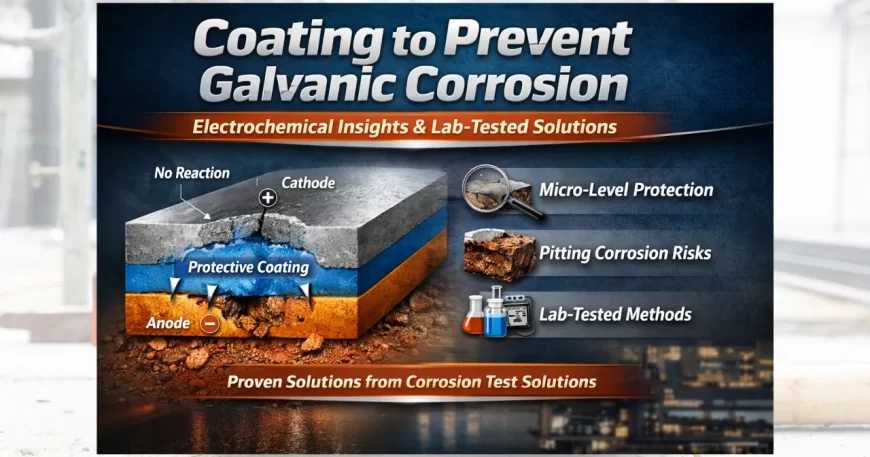
When dissimilar metals share an environment with moisture or an electrolyte, they form a tiny battery. One metal corrodes faster, the anode, while the other, the cathode, stays mostly intact. That anode metal often develops localized weaknesses, a phenomenon engineers call pitting corrosion. It’s deceptive because the damage can be microscopic, but the structural consequences are anything but minor. Pipes, joints, marine hardware, and industrial machinery, none of these are immune.
We don’t just test metals for curiosity’s sake. At Corrosion Test Solutions, we measure these interactions carefully, determining which metal pairings, environments, and stressors will trigger the most aggressive corrosion. Understanding the problem is the first step; controlling it comes next.
How Coatings Interrupt the Electrochemical Cycle
A coating to prevent galvanic corrosion acts as a barrier, but not just any barrier. It isolates metals from each other and from the electrolytes that carry ions. Done properly, it evens out electrical potentials and prevents those dangerous micro-cells from forming. The coating also buys time, corrosion reactions slow, surfaces stay intact, and maintenance schedules become manageable instead of urgent.
We’ve found that the type of coating matters as much as its application. Some polymers resist moisture penetration; certain metallic layers bond tightly to substrates. The trick isn’t just picking a material, it’s ensuring it stays intact under real-world conditions. Even a tiny flaw, a pinhole, or a scratch can invite pitting corrosion to start quietly under the surface.
Micro-Level Insights from the Lab
At Corrosion Test Solutions, our electrochemical tests aren’t abstract exercises. We watch corrosion happen in real time, measuring potentials and resistances. These tests tell us how well a coating holds up under stress and how it works with different types of metal. It’s interesting to see how the smallest interactions can affect the long-term future of a structure.
By understanding this micro-level behavior, we can recommend coatings tailored to the situation. A pipe exposed to seawater will need different treatment than an industrial tank handling chemicals. We’re not guessing; we’re interpreting data, patterns, and subtle electrochemical signatures.
Field Applications: Where Theory Meets Practice
You can’t fully appreciate a coating’s value until you see it in action. Offshore platforms, automotive assemblies, architectural metalwork, every project is a little puzzle of metal types, environmental stressors, and exposure conditions. The right coating to prevent galvanic corrosion transforms vulnerable assemblies into resilient systems.
We’ve advised clients who were ready to replace expensive components prematurely. A properly selected coating, combined with routine monitoring, stopped corrosion in its tracks. It’s not glamorous, but it’s effective, and in this business, effectiveness beats hype every time.
Maintaining the Protection
Even the best coatings need attention. Micro-level flaws show up over time as the environment changes. Our team stresses the importance of regular checks to catch any signs of corrosion before it spreads. If you find a coating early enough, it can be more than just a protective layer; it can be a long-term investment in the metal’s strength.
Conclusion
Galvanic corrosion is hard to see, but the damage it causes is very clear. Metals stay strong, predictable, and reliable as long as they are coated carefully to stop galvanic corrosion, and someone is always watching for pitting corrosion metal. We at Corrosion Test Solutions use a mix of lab accuracy, field experience, and a little bit of gut feeling from years of watching how metals act under stress. We don’t just protect metals at the micro level; we also promise to keep our clients safe, efficient, and at ease.
FAQs
Q1. What is galvanic corrosion?
Galvanic corrosion occurs when two dissimilar metals connect in a corrosive environment, causing one metal to corrode faster.
Q2. How does a coating prevent galvanic corrosion?
A coating isolates metals from each other and moisture, stopping electrochemical reactions that lead to corrosion.
Q.3 What is pitting corrosion of metal?
Pitting corrosion is localized metal damage, creating small, deep pits that compromise structural integrity and accelerate corrosion.
Q4. Which metals need coatings to prevent galvanic corrosion?
Metals like aluminum, steel, and copper alloys often require protective coatings when used together in humid or marine environments.
Q5. How does Corrosion Test Solutions help protect metals?
We test metals electrochemically, recommend coatings, and monitor performance to prevent galvanic corrosion and pitting corrosion.