Our Achivements
About
Electochemical Corrosion Testing Solutions
Corrosion testing allows to determine the proper selection of materials for use in a given corroding environment. Metal alloys exposed to a corroding environment will experience continuous destructive degradation from uniform or localized corrosion that can lead to failure, posing economic losses and safety risks.
Uniform or localized corrosion attack is caused by electrochemical corrosion reactions on the corroding surface. The reactions involve anodic oxidation conducing to oxide formation, mass loss, or localized attack; and a simultaneous reduction reaction leading to hydrogen absorption in some corroding environments which can cause structural damage and meal embrittlement. Alloys prone to hydrogen embrittlement can be susceptible to cracking under stress. The referred corrosion reactions can be simulated during electrochemical testing of metal samples to assess their compatibility with the corroding environment.
At CT&S we evaluate the corrosion behavior of metal alloys relevant to your corroding environment using state of the art bench top electrochemical instruments.
Our Mission
Addressing Corrosion and Testing Needs.
Addressing corrosion issues in the field or in a plant process environment requires a good understanding of the corrosion characteristics of the metal parts in such corroding environment. When you contact CT&S, we will help you take the steps to solve corrosion issues for best results in your operating conditions. We will test your metal parts according to your specific needs providing experimental procedure, test results, data, discussions, conclusions, and recommendations. Tell us about your metal corrosion issues. Email your request by completing and submitting the request form in our CONTACT US page. You can also call as at 608-347-494
Experts Collaborating At CT&S

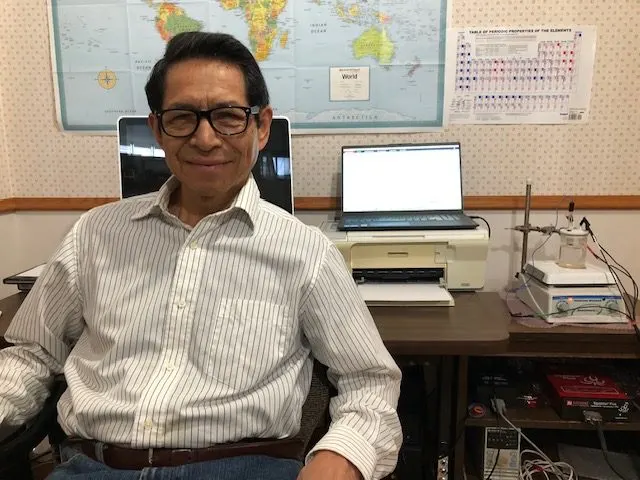
Edgar Armacanqui
Dr. Armacanqui has over 25 years of experience in materials science, corrosion science, and metallurgical engineering. His experience covers applications of electrochemical techniques to corrosion studies and materials performance. His areas of practice include corrosion, metallography, optical imaging, surface and structural analysis by SEM, TEM, X-Ray diffraction, and infrared spectroscopy, as well as mechanical testing and failure analysis.

Marc A Anderson
Dr. Anderson has over 25 years of experience in chemistry and materials applications. He has done research on engineering materials and energy use. Dr. Anderson is an expert in environmental technology, corrosion control, metal passivation by particle suspension coating techniques, water treatment processes, energy storage, CO2 purification, materials synthesis and characterization, and concrete improvement.

M. Isabel Tejedor
Dr. Tejedor has over 20 years of experience in Environmental Chemistry, thin film technology, and electrophoretic deposition. She is also an expert in electrochemistry, corrosion inhibition with nano porous materials, thin film oxides, water chemistry, thin film sol gel technology, solar cells, and porous oxide electrolyte membranes for fuel cells.
