

Request A Quote
Stress Corrosion Cracking Testing for Steels & Metals
Stress Corrosion Cracking Failure
Stress Corrosion Cracking (SCC) is the sudden and premature brittle failure of ductile alloys due to the combined action of tensile stress, a corrosive environment containing chloride or sulfide, and temperatures near or above 40 ºC. The required stress may be above or be a fraction of the material’s yield stress. The stress can be applied or be an internal residual stress introduced during fabrication, cold deformation, forming, welding, heat treatment, machining, or grinding.
Materials susceptible to SCC are austenitic and duplex stainless steels in concentrated chloride solutions; duplex alloys, carbon steel, and Cr-Mo low-alloy steels in solutions with hydrogen sulfide; pipeline steels in solutions of carbonate or bicarbonate containing chloride and sulfide; cupronickel alloys in seawater containing sulfur anion or ammonium cation; as well as sensitized stainless steels with precipitated chromium carbides at grain boundaries exposed to chloride solutions. Of the factors affecting the sensitivity to SCC, chloride containing mediums impacts most alloys, such as Iron-based steels used in pipelines for fluid transportation. Even traces of chloride, in conjunction with sustained tensile stresses and warm temperatures enhances the sensitivity to SCC.
Hydrogen embrittlement (HE) is a main model considered to lead to SCC. For high strength steels, HE is the predominant SCC mechanism. The source of H arises from cathodic corrosion reactions at the metal surface which lead to atomic hydrogen absorption and diffusion into the corroding metal where it builds up to induce HE. Stress corrosion failure from hydrogen embrittlement is characterized by brittle fracture, as exhibited below for a steel pipeline.
To minimize hydrogen-assisted cracking, reducing exposure to sources of hydrogen and reducing residual stresses is necessary. In some cases, the initiation of cracking is highly dependent on the presence of moisture. A typical example is cracking in the weld zone of transmission pipelines, as displayed in the attached graph which shows a crack along the surface path of a tape wrap where moisture likely collected to induce corrosion and hydrogen generation; followed by absorption, diffusion, hydrogen build up, and then metal embrittlement.
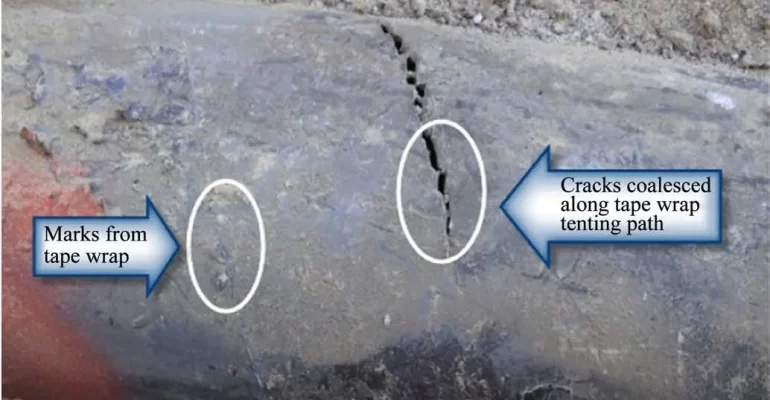
Brittle fracture in the welded section of a steel pipeline due to stress corrosion. The crack coalesced along the tape wrap tenting path where moisture likely collected to induce corrosion, hydrogen absorption, embrittlement, and metal cracking. [Canadian Energy Pipeline Association, in “Stress Corrosion Cracking-Recommended Practices”, 2nd Ed. CEPA, 2007. Exert from Krivonosova, E.A.,vp. 3 (2018).