• Home
  • Why Is Corrosion Testing Important?

Why Is Corrosion Testing Important?

Why Is Corrosion Testing Important 2nd image

Corrosion

Importance of Corrosion Testing.

Industries that use metallic materials in mild or aggressive environments rely on the metal’s corrosion performance. Generally, materials specifications on metal alloys for use in most industries include chemical and metallurgical composition as well as physical and mechanical properties. The corresponding corrosion resistance requirements are sometimes lacking or incomplete. Testing a material’s behavior in a given working corroding environment will determine its suitability for such environment.

Nearly all metal alloys experience uniform or localized corrosion attack, which can be severe in aggressive chloride or other halide ion atmospheres, or in ambients containing carbon dioxide, hydrogen sulfide, water, and dissolved oxygen. The attack can start from exposure to moisture or from pre-existing residual hydrogen in the metal alloy.

Testing the conditions to which your alloys are to be exposed will lead to selecting a proper alloy. Factors impacting metal corrosion are type of alloy, treatment history, metallurgical composition, pH, composition of the corroding environment, temperature, and state of internal residual stress or externally applied stress to the metal.

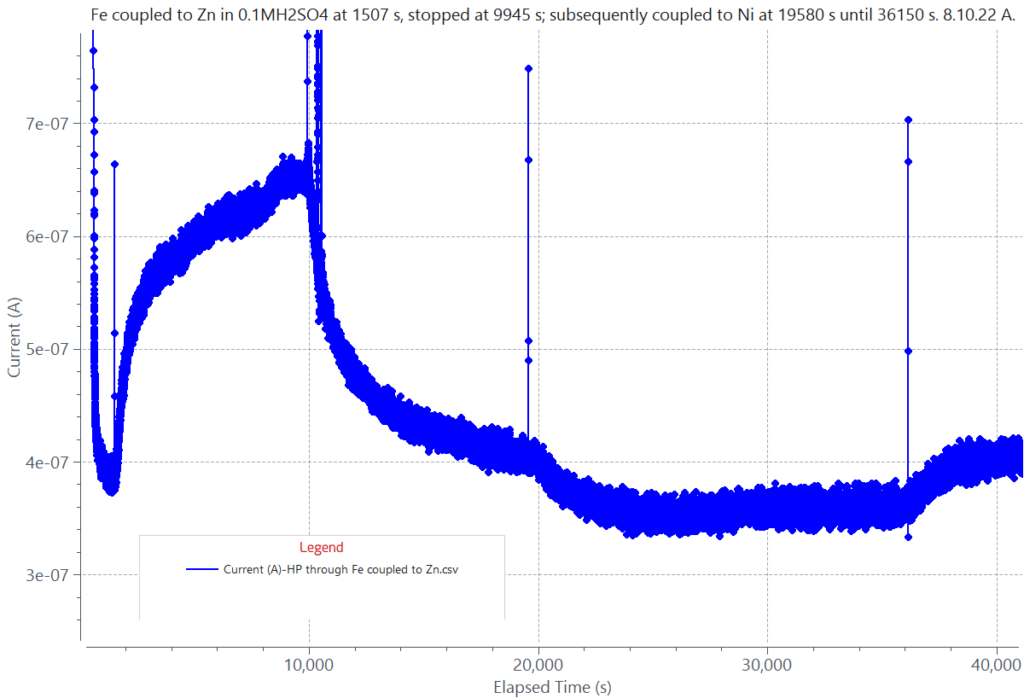
The attached graphical electrochemical corrosion data was generated using a hydrogen permeation electrochemical cell holding an iron (Fe) sample separating two compartments, one anodic and the other cathodic. The graph shows current decays, due to oxidation reactions taking place on the iron surface facing the anodic compartment containing 0.1N NaOH. Current rises in the graph were caused by reduction reactions on the iron surface facing the cathodic compartment containing 0.1M H2SO4. Hydrogen (H) is generated in the cathodic compartment by galvanic corrosion or by free corrosion of the iron surface. In the opposite iron surface in contact with 0.1N NaOH, an oxidizing anodic potential is applied to measure the H flux permeating through the iron plate due to its galvanic coupling to zinc (Zn) or due to the iron free corrosion. The magnitude of the current rise to a steady state value indicates the rate at which hydrogen is diffusing through the metal membrane.

Assessing the metal’s corrosion response to its environment is essential and beneficial to many industries relying on metals including manufacturing, chemical, electrochemical, petrochemical, oil, refinery, construction, transportation, automotive, aerospace, energy, water cooling systems, utility, mining, electronics, food, health, and medical industry. At Corrosion Testing & Solutions, LLC (CT&S), we will test your materials in environments relevant to your production process conditions.

Oxidation current decays and reduction current rises data from iron (Fe) due to: a) Fe coupling to Zn, causing H generation and its permeation through Fe (1507 s to 9945 s); b) Fe coupling to Ni, causing oxidation of Fe and a current decay (19580 s to 36150 s); and c) Fe free corrosion in 0.1M H2SO4 (36150 s to 42000 s) after stopping Fe coupling to Ni at 36150 s. The initial fast current decay to about 400 nA is due to an oxidation potential applied to Fe exposed to 0.1N NaOH done to measure the H flux through Fe during stages (a) or (c). The current decay from 9945 s to 19580 s is due to the decrease in H flux through iron, after stopping the Fe-Zn coupling at 9945 s.

Disclaimer

The information contained in this website and on related work reports from Corrosion Testing & Solutions, LLC (CT&S) is for general information purposes only and does not constitute professional advice of any kind. The information is provided by Corrosion Testing & Solutions, LLC (CT&S). While we attempt to keep the information up to date and correct, we make no representations or warranties of any kind, express or implied, about the completeness, accuracy, reliability, suitability or availability with respect to the website or the information, products, services, or related graphics contained on the website and on related work reports from CT&S for any purpose. Any reliance you place on such information is at your own risk.
In no event will we be liable for any loss or damage including without limitation, indirect or consequential loss or damage, or any loss or damage whatsoever arising from loss of data or profits arising out of, or in connection with, the use of this website or the use of related work reports from CT&S. Users of this website cannot make use of the original content stated here without the permission of Corrosion Testing & Solutions, LLC. Through this website you are able to link to other websites which are not under the control of CT&S. We have no control over the nature, content and availability of those sites. The inclusion of any links does not necessarily imply a recommendation or endorsement of the views expressed within them. Every effort is made to keep the website up and running smoothly. However, CT&S takes no responsibility for, and will not be liable for, the website being temporarily unavailable due to technical issues beyond our control.