• Home
  • Corrosion Inhibition

Corrosion Inhibition

Corrosion Solutions

The first line of defense against corrosion is having an unperturbed native oxide film that serves as an effective barrier to moisture, oxygen, and other corrosive elements; as found in stainless steels and a few other alloys. However, for certain applications, stainless steels and most other alloys require additional surface protection against corrosion. Different types of surface films, coatings, or inhibitors can be used to form a protective  barrier against corrosion. At CT&S, we can determine the inhibition efficiency of passivating films, coatings, or inhibitors selected for a given metal alloy and corroding environment.

Another form of corrosion inhibition is by cathodic protection, a cathodic polarization technique practiced to protect steel structures buried in soil or embedded in concrete exposed to marine or other aggressive environments. In Cathodic Protection, the metal structure is polarized cathodically using a sacrificial anode or by impressing a current with a direct current (DC )source.

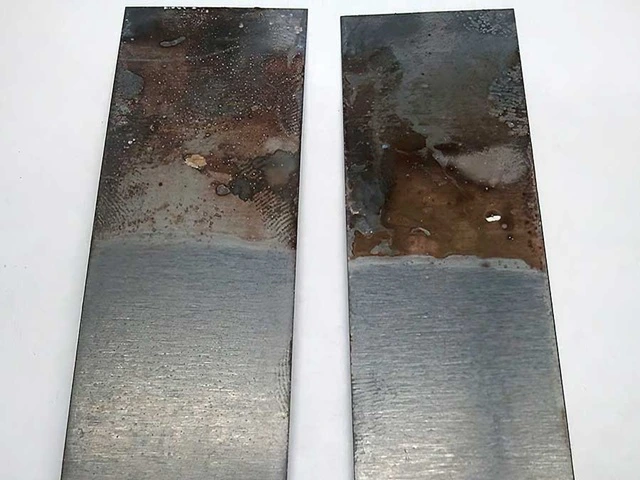
New passivation methods have been developed in recent years using nano particle coating. Passivation using microporous oxide nanoparticle suspensions results in a largely improved corrosion resistance of stainless steel (SS), carbon steel, and aluminum. The metal oxide porous thin film is prepared from nano particulate dioxides of metals such as titanium, silicon, or zirconium. The top figure shows two stainless steel plates after exposure to moist air. The non-corroded bottom-half surfaces were coated with a film of nano particles, unlike the corroded uncoated top-half surfaces.

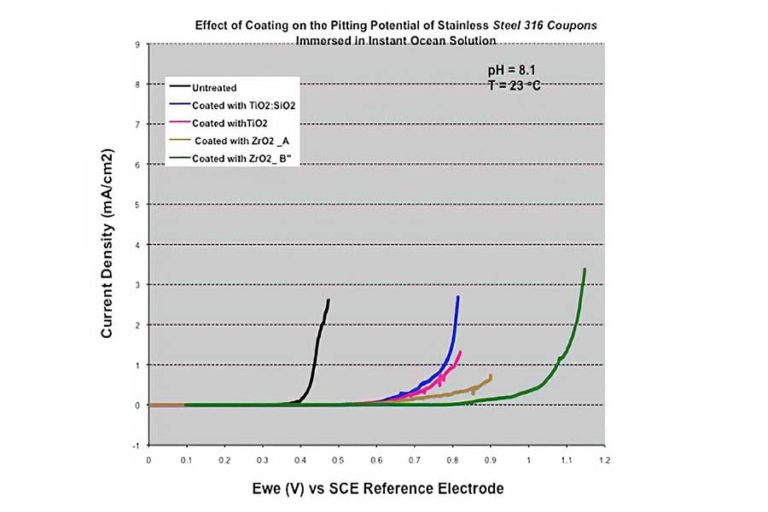
A metal surface coated with a nanoparticle coating can have a largely increased pitting potential, which translates in a substantial enhancement in pitting resistance. The green curve in the adjacent figure shows an increase of more than 0.5V in pitting potential for 316 SS coated with a nano particle oxide of zirconium, relative to the pitting potential of uncoated 316 SS (black curve). If you are interested in the microporous oxide application, contact us at MOST (608-345-6678).

Disclaimer

The information contained in this website and on related work reports from Corrosion Testing & Solutions, LLC (CT&S) is for general information purposes only and does not constitute professional advice of any kind. The information is provided by Corrosion Testing & Solutions, LLC (CT&S). While we attempt to keep the information up to date and correct, we make no representations or warranties of any kind, express or implied, about the completeness, accuracy, reliability, suitability or availability with respect to the website or the information, products, services, or related graphics contained on the website and on related work reports from CT&S for any purpose. Any reliance you place on such information is at your own risk.
In no event will we be liable for any loss or damage including without limitation, indirect or consequential loss or damage, or any loss or damage whatsoever arising from loss of data or profits arising out of, or in connection with, the use of this website or the use of related work reports from CT&S. Users of this website cannot make use of the original content stated here without the permission of Corrosion Testing & Solutions, LLC. Through this website you are able to link to other websites which are not under the control of CT&S. We have no control over the nature, content and availability of those sites. The inclusion of any links does not necessarily imply a recommendation or endorsement of the views expressed within them. Every effort is made to keep the website up and running smoothly. However, CT&S takes no responsibility for, and will not be liable for, the website being temporarily unavailable due to technical issues beyond our control.