• Home
  • Corrosion Impact On Materials

Corrosion Impact On Materials

Corrosion Issues and Testing Solutions

All metal alloys are prone to be degraded when they are exposed to a corroding medium or to adverse environmental factors including moisture, oxygen, and salt. At Corrosion Testing & Solutions, LLC (CT&S), we do corrosion testing and provide training to help your business address corrosion issues. Protection against corrosion failure starts with testing and selecting suitable metal alloys for best service in a given corroding environment. Our services are oriented to all industries that process or use metal alloys exposed to corroding aqueous or moist environments.

Corrosion is caused by oxidation and reduction reactions taking place at the corroding surface in contact with the corroding medium. These two types of reactions can independently lead to failure. The oxidation reactions cause metal thinning or localized attack, subject to the type of alloy and the corroding conditions. The reduction reactions can cause harmful hydrogen absorption by the corroding metal in acidic or alkaline environments. The absorption and diffusion of hydrogen into the corroding metal can induce lattice defects, lattice deformation, and stress build up; which can result in metal embrittlement and sudden failure in some alloys.

The wrong combination of type of alloy, aggressive components in the corroding environment, pH, temperature, and state of internal residual stress or externally applied stress to the alloy can lead to accelerated metal corrosion and metal failure. Pitting corrosion, crevice corrosion, inter-granular corrosion, stress corrosion cracking, as well as uniform corrosion can each conduce to catastrophic failures.

At CT&S we are equipped to evaluate the corrosion performance of ferrous and nonferrous alloys simulating your corroding medium using electrochemical techniques to determine corrosion rate and type of corrosion attack. This technique is fast and very reliable. Longer term immersion corrosion testing using ASTM G31 is also performed.


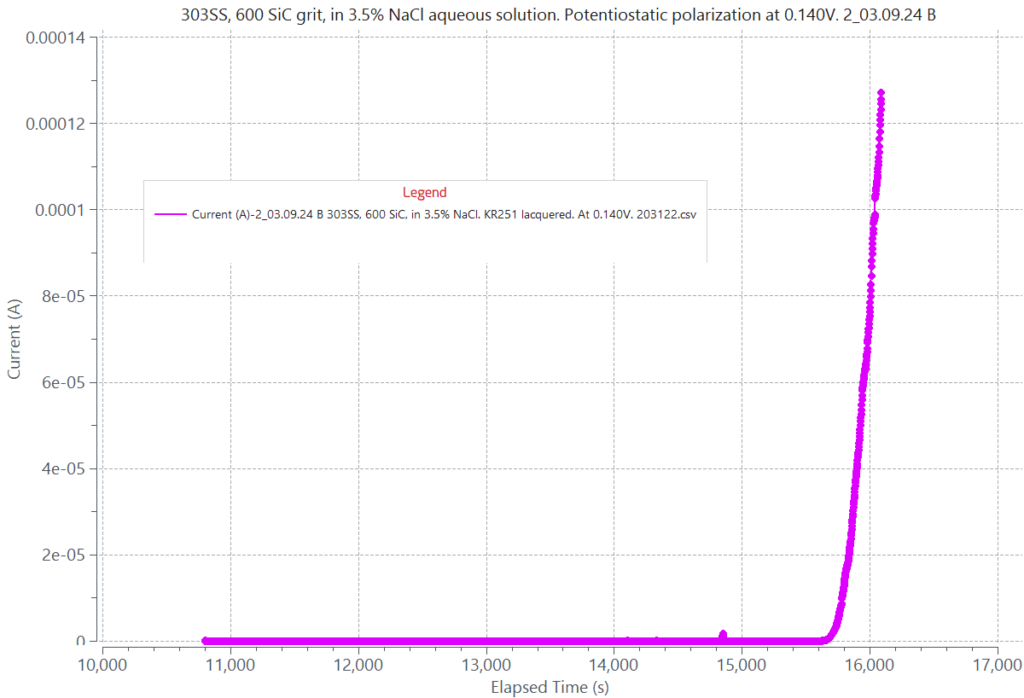
Graph displaying pitting corrosion of 303 stainless steel (SS) in 3.5% NaCl aqueous solution during pototentiostatic polarization at 0.140V above its corrosion potential. A sudden sharp and continuous current rise is seen at 4900 seconds from the start of polarization. The rise in current is due to a breakdown of the protective oxide film on 303 SS caused by chloride. leading to pitting corrosion attack.

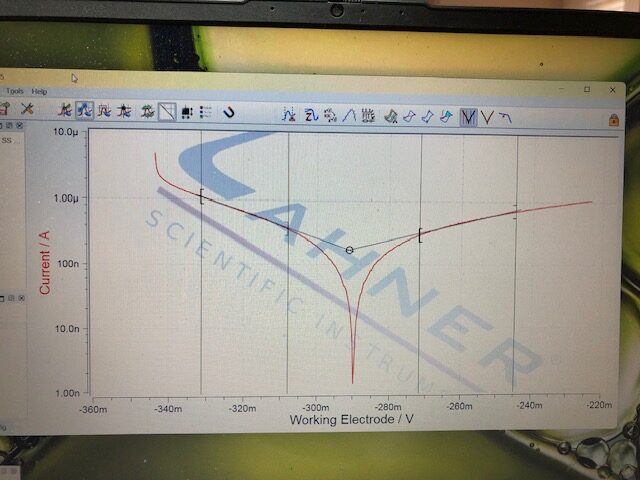
Graph generated from corrosion of 303 stailess steel in NaCl-saturated aqueous solution. The corresponding uniform corrosion rate determined by Tafel polarization is 1.44 µA/cm2 at room temperature. The chloride content in the corroding solution will induce pitting corrosion causing a metal dissolution rate much higher than 1.44 µA/cm2.

Disclaimer

The information contained in this website and on related work reports from Corrosion Testing & Solutions, LLC (CT&S) is for general information purposes only and does not constitute professional advice of any kind. The information is provided by Corrosion Testing & Solutions, LLC (CT&S). While we attempt to keep the information up to date and correct, we make no representations or warranties of any kind, express or implied, about the completeness, accuracy, reliability, suitability or availability with respect to the website or the information, products, services, or related graphics contained on the website and on related work reports from CT&S for any purpose. Any reliance you place on such information is at your own risk.
In no event will we be liable for any loss or damage including without limitation, indirect or consequential loss or damage, or any loss or damage whatsoever arising from loss of data or profits arising out of, or in connection with, the use of this website or the use of related work reports from CT&S. Users of this website cannot make use of the original content stated here without the permission of Corrosion Testing & Solutions, LLC. Through this website you are able to link to other websites which are not under the control of CT&S. We have no control over the nature, content and availability of those sites. The inclusion of any links does not necessarily imply a recommendation or endorsement of the views expressed within them. Every effort is made to keep the website up and running smoothly. However, CT&S takes no responsibility for, and will not be liable for, the website being temporarily unavailable due to technical issues beyond our control.