Request A Quote
Expert Analysis of Metal Pitting Corrosion in Industrial Applications
Pitting Corrosion Testing and Solutions
Pitting corrosion is a form of extremely localized corrosion attack that can lead to metal perforation. It occurs in metal alloys that form a protective thin surface oxide film such as stainless steels (SS) and alloys of aluminum, zinc, nickel, titanium, and magnesium. The corrosion rate inside pits can be several orders of magnitude greater than that typically found during uniform corrosion of these alloys. This type of corrosion attack occurs in the presence of chloride, bromide, iodide, fluoride, or sulfates. Pipes used in industrial applications fail typically by perforation caused by localized pitting attack. Prevention of pitting attack is possible by proper alloy selection, suppressing exposure to chloride, using barrier coatings or other protective surface treatments.
Localized pitting attack in non-chloride aqueous environments can happen from microbial corrosion. This process creates a microenvironment distinct than that of the bulk environment in pH, dissolved oxygen, and the presence of organic and inorganic species. The process forms biofilms and byproducts such as sulfides and acids that lead to the breakdown of the protective oxide film. Alloys of copper, aluminum, and nickel, as well as steels, are susceptible to corrosion and pitting attack by microbial corrosion. Copper pipes and tubings used for water lines are known to develop pinhole leaks attributed to pitting from microbial induced corrosion (MIC).
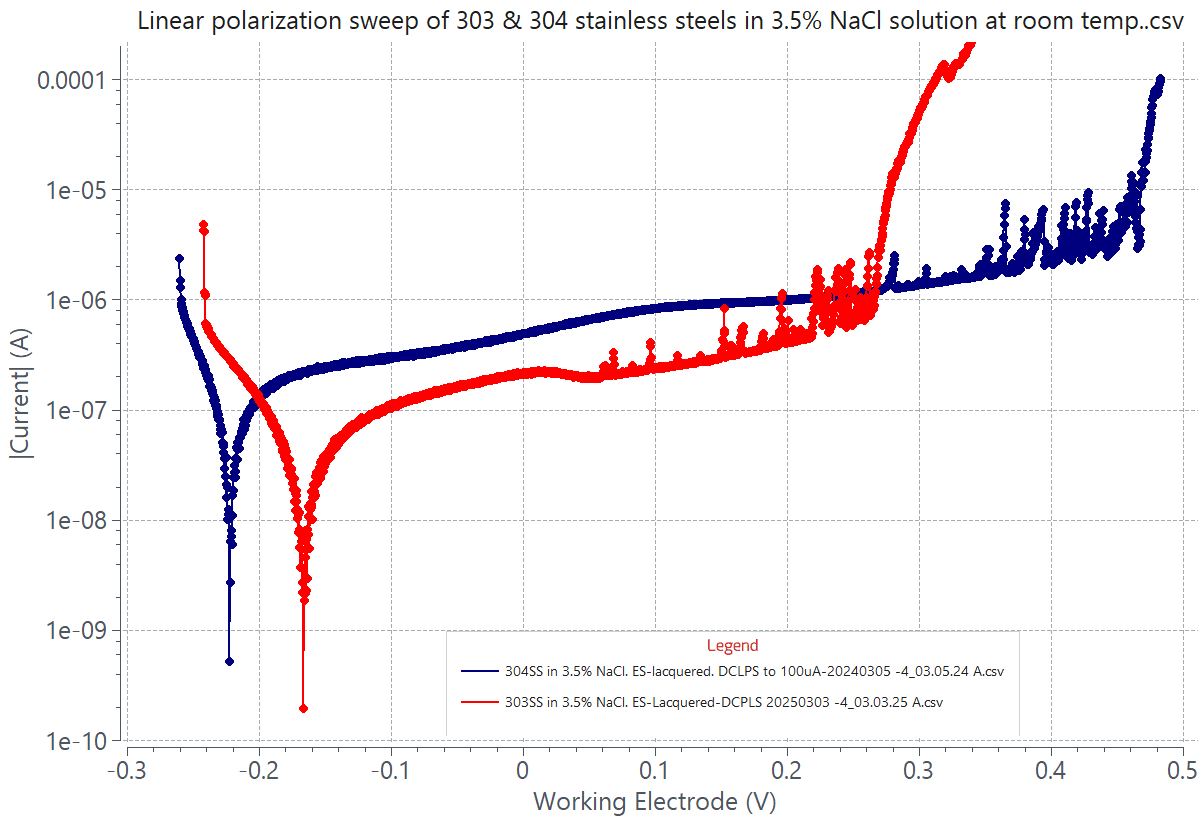
Pitting corrosion is evaluated according to ASTM G46 and it is measured by a cyclic potentiodynamic polarization test according to ASTM G61 for iron, nickel, and cobalt-based alloys. During the cyclic polarization sweep, pitting is detected when a sudden rapid and continuous current rise is observed once the metal’s pitting potential is reached. The pitting potential defines the onset of stable pit growth. Some alloys can be ranked based on their pitting potential value. The more anodic the pitting potential of an alloy is, the more resistant to pitting attack the alloy is. The graph below compares the polarization behaviors of 303 (red line) and 304 (blue line) stainless steel in a marine-like solution containing 3.5% NaCl. The graph shows that 304 SS has better pitting corrosion resistance than 303 SS. Pitting is also determined potentiostatically by applying constant potentials above the corrosion potential and measuring the generated current over time, as shown in the adjacent graph for 304 SS in NaCl-saturated aqueous solution polarized at 0.300 V.
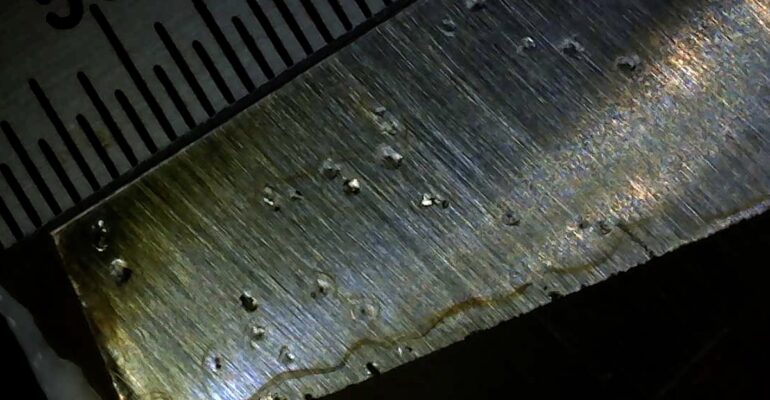
Random pits formed on 304 stainless steel after polarizing this alloy in 3.5% NaCl solution to potentials beyond its pitting potential at 0.460 V vs. Ag/AgCl. The respective polarization graph is the blue line in the bottom left graph which compares the potential polarization behavior between 303 SS (red line) with that of 304 SS (blue line).

Potential polarization sweep of 2 cm2 area 303 (red line) and 4 cm2 area 304 (blue line) stainless steel in 3.5% NaCl-aqueous solution. Both alloys exhibit pitting attack and fast metal dissolution revealed by the rapid and continuous rise in current at 0.265 V for 303 SS and at 0.460 V for 304 SS; relative to a Ag/AgCl reference electrode. The regions in both graphs displaying small intermittent sharp rises in current define a metastable pitting stage at which newly formed pits quickly re-passivate.
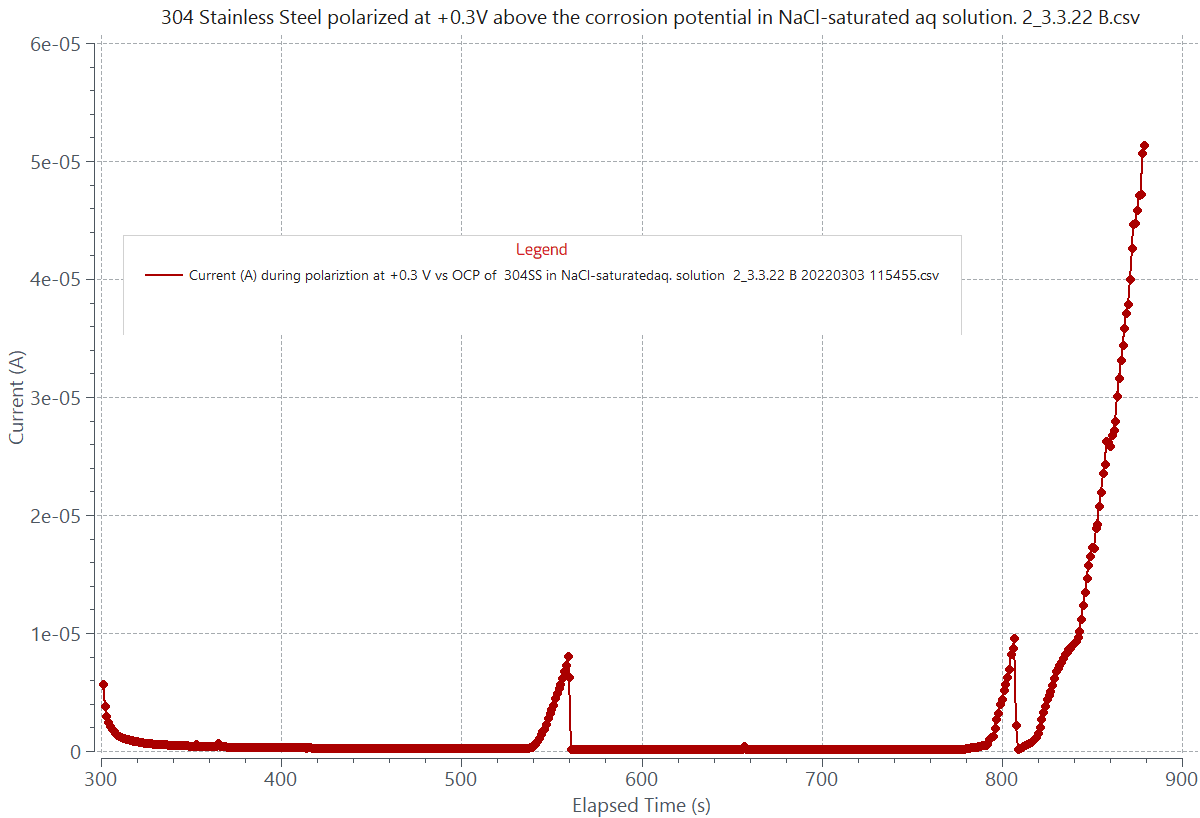
Pitting behavior of 1 cm2 area 304 stainless steel during potentiostatic polarization at +0.300 V above its open circuit potential vs. Ag/AgCl reference electrode in a NaCl-saturated aqueous solution (NaCl content greater than 3.5% NaCl). Stable pit growth is revealed by a continuous current rise observed 520 s from the start of the polarization. The small current spikes at 560 s and at 810 s correspond to oxide breakdown-repassivation events.
